Why yoga in addiction recovery matters
Hatch Behavioral Health is proud to welcome Roni Amrich as our Yoga & Mindfulness Partner. Roni leads Hatch’s yoga and mindfulness program, giving clients a practical, body-based tool for managing stress and staying grounded in recovery.
Talk therapy helps people understand what they’re carrying. Movement and breath help them feel it, release it, and find steadier footing. That’s the heart of yoga in addiction recovery, and it’s why yoga is woven into our women’s treatment programs alongside clinical care.
The research is promising, too. The National Institutes of Health’s National Center for Complementary and Integrative Health notes that mindfulness-based approaches may help people reduce substance use, and that early studies of yoga are positive.
Meet Roni Amrich
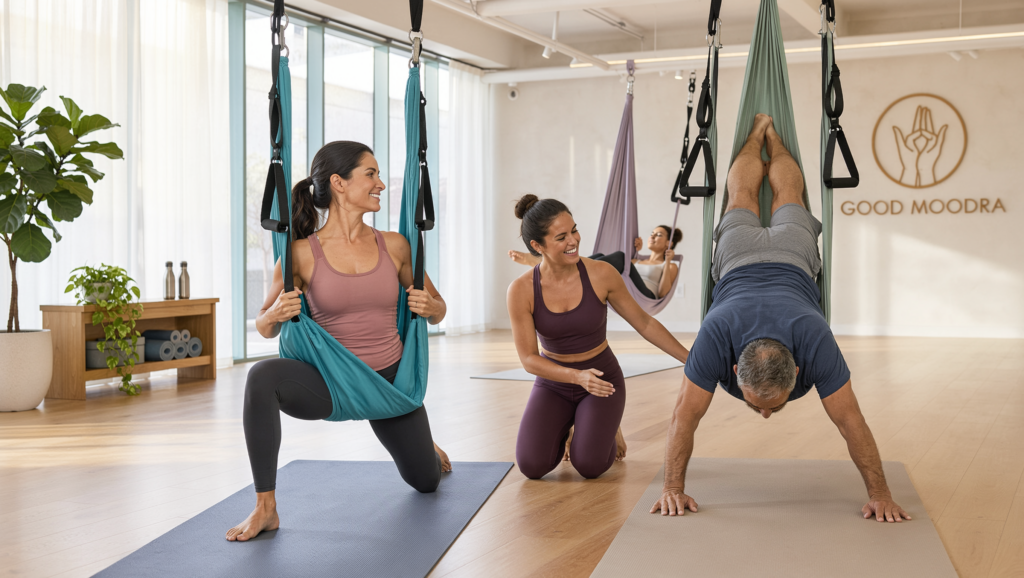
Roni is a registered yoga teacher and the owner of Good Moodra Trapeze Yoga, the only trapeze yoga studio in Orange County. She trained at YOGABODY in Spain under founder Lucas Rockwood and has been teaching since opening her studio in 2020.
Good Moodra also operates as a registered yoga school, where Roni trains new instructors. That means Hatch clients learn from someone who doesn’t just teach yoga, but teaches teachers how to make it safe, welcoming, and accessible.
A change of scenery is part of the therapy
Hatch clients attend private classes with Roni at her Orange County studio. Stepping outside the treatment setting is intentional. For an hour, clients are in a space built around movement and joy, not diagnoses and schedules.
That shift in environment gives people room to breathe, try something new, and experience themselves differently. It complements the clinical work happening in our Partial Hospitalization (PHP) and Intensive Outpatient (IOP) programs, where yoga and mindfulness sit alongside our other therapy services.
“Do what your body wants to do today”
Roni’s approach fits naturally with Hatch’s philosophy of meeting clients where they are, whoever they are and wherever they’re starting from. Every class is designed so that someone who has never worked out and someone with years of practice can participate side by side. Each movement is layered, so there is always an accessible starting point.
Her guiding reminder is simple: “Do what your body wants to do today.”
Clients who aren’t ready to participate are welcome to sit and observe. Roni has learned that the most important thing she can offer is patience with wherever someone is that day. There’s no pressure to perform, only an open invitation to join when it feels right.
A coping skill with room for joy
Roni describes yoga as “a coping skill that helps people cope with stress.” She has seen clients who started on the sidelines go on to complete a full class, discover their own strength, and carry the practice into their lives beyond treatment.
And her classes aren’t silent or solemn. They make room for laughter, too. As Roni puts it: “Why make it so serious? We’re supposed to experience joy.”
For many people in recovery, rediscovering joy is part of the work. A class where it’s okay to wobble, laugh, and try again is a powerful place to practice it, and it’s one of the most overlooked benefits of yoga in addiction recovery.
Try it now: pursed-lip breathing
One of the first skills Roni teaches is pursed-lip breathing. You can use it anywhere, in any stressful moment, long after class ends.
- Inhale gently through your nose for a count of two.
- Purse your lips as if you were about to blow out a candle.
- Exhale slowly for twice as long, a count of four, like blowing a feather across a table.
- Repeat for a few rounds, letting your shoulders soften with each exhale.
It’s simple, it’s free, and no one around you has to know you’re doing it. Cleveland Clinic notes that pursed-lip breathing can help reduce stress and calm anxiety. If you feel dizzy or lightheaded, pause and breathe normally, and check with your healthcare provider if you have a lung or heart condition.
Healing that meets you where you are
At Hatch Behavioral Health, we believe recovery should engage the whole person: mind, body, and spirit. Our partnership with Roni Amrich and Good Moodra Trapeze Yoga brings yoga in addiction recovery to life, giving clients a place to build strength, release stress, and rediscover joy at their own pace.
Ready to take the next step? Call our admissions team at (714) 942-4742, verify your insurance, or contact us to learn how yoga and mindfulness can be part of your care.
Helpful resources
- 6 Things To Know About Psychological and Physical Approaches for Substance Use Disorders (NCCIH)
- Pursed-Lip Breathing: Technique, Purpose & Benefits (Cleveland Clinic)
- SAMHSA National Helpline: free, confidential, 24/7 at 1-800-662-4357
- 988 Suicide & Crisis Lifeline: call or text 988