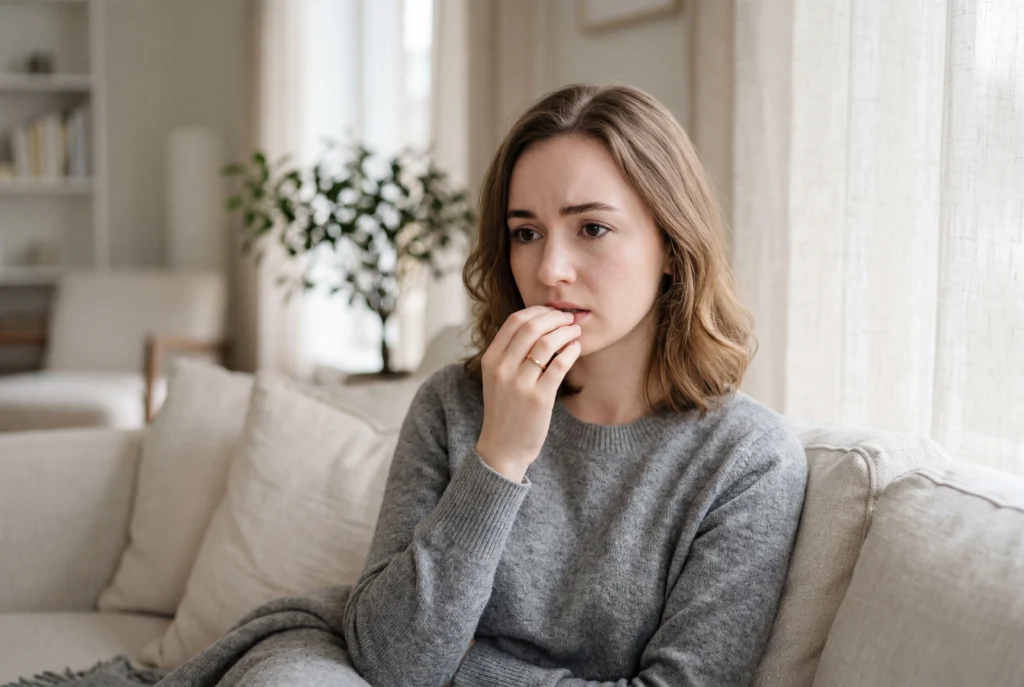
You stopped drinking expecting to feel better, or at least steadier. Instead, a few days in, the anxiety showed up louder than it ever was before — a racing heart at 3am, a low hum of dread that follows you through an ordinary Tuesday, a jumpiness that makes even small decisions feel harder than they should. If you’re wondering what’s wrong with you, here’s the honest answer: probably nothing new. Anxiety after quitting drinking is a well-documented, biologically explainable pattern, not a sign that quitting was a mistake or that something’s broken in you.
Why This Happens: The Brain’s Rebound Effect
Alcohol works, in the moment, by enhancing a calming brain chemical called GABA while suppressing an excitatory one called glutamate — which is exactly why a drink can feel like it takes the edge off. But the brain doesn’t like staying out of balance, so with repeated drinking, it compensates by producing less GABA and more glutamate on its own, trying to return to equilibrium while alcohol keeps pushing the scale the other way.
When you stop drinking, that compensation doesn’t reverse instantly. According to the National Institute on Alcohol Abuse and Alcoholism, the withdrawal phase is specifically characterized by decreased reward-circuit activity alongside activated stress circuits — a combination that directly fuels anxiety, low mood, and irritability. In plain terms: your brain is temporarily running with less of its natural “brake” and more of its natural “gas,” until it recalibrates back to its own baseline without alcohol’s involvement. That mismatch is what you’re feeling, and it has a real physiological cause, not a mysterious one.
How Long Does This Usually Last?
This varies by individual, by how much and how long someone was drinking, and by factors that aren’t always predictable in advance — but generally, this kind of rebound anxiety tends to peak in the first several days after stopping and gradually improves over the following weeks as brain chemistry re-stabilizes. For some people, milder anxiety symptoms can linger longer, sometimes described as part of a broader pattern of post-acute symptoms that persist past the initial withdrawal period.
It’s worth naming clearly: if anxiety after stopping drinking is severe, includes physical symptoms like a racing heart, tremors, or a sense of panic that feels unmanageable, or if you were drinking heavily and consistently before stopping, that’s a signal to involve a medical professional rather than waiting it out alone — sudden, unsupervised withdrawal from heavy alcohol use can carry real medical risk, and this is genuinely one of the situations where professional guidance matters most.
Is This Just Withdrawal, or Was the Anxiety There All Along?
This is often the more confusing question, and there isn’t always a clean answer. Some anxiety after quitting is purely the rebound effect described above, and it fades as the brain recalibrates. But for a meaningful number of people, alcohol was originally being used, at least in part, to manage anxiety that predated the drinking — which means once alcohol is removed, some portion of what surfaces isn’t rebound at all, it’s the original anxiety finally visible without anything muting it. According to the National Institute of Mental Health, roughly 19% of U.S. adults experience an anxiety disorder in a given year, which means a lot of people getting sober are also, independently, managing a real anxiety condition that has nothing to do with withdrawal timelines.
There’s no need to solve this distinction alone or immediately. Time is actually one of the more useful diagnostic tools here: rebound anxiety that’s purely withdrawal-related tends to noticeably ease within a few weeks. Anxiety that persists well past that window, or that doesn’t follow the expected rebound pattern, is worth discussing with a clinician as its own condition, deserving of its own treatment rather than something to simply wait out.
What Helps While Your Brain Recalibrates
A few things can genuinely help during this window, without requiring anything dramatic. Consistent sleep, even when anxiety makes sleep harder to come by, supports the same neurochemical systems that are trying to restabilize. Regular meals and hydration matter more than they might seem to, since alcohol withdrawal already puts real physical strain on the body. Gentle movement — a walk, stretching, anything that discharges some of the physical restlessness anxiety produces — can meaningfully take the edge off without requiring intense exercise.
It’s also genuinely helpful just to have language for what’s happening. Naming this as a known, temporary, biologically explainable process — rather than a personal failure or evidence that sobriety isn’t working — tends to reduce the secondary anxiety that comes from being anxious about being anxious, which is a real and common compounding factor.
When It’s a Sign of Something More
If anxiety persists well beyond the expected withdrawal window, if it’s severe enough to interfere significantly with daily functioning, or if you suspect the anxiety predates the drinking and was part of what the drinking was managing in the first place, that’s worth a real clinical conversation rather than continued self-management. This is often where the picture starts to look like dual diagnosis — anxiety and substance use intertwined closely enough that addressing only one side leaves the other free to keep driving the cycle. IOP built around treating both together, rather than assuming sobriety alone will resolve underlying anxiety, tends to produce more lasting results than waiting to see if the anxiety fades on its own.
Frequently Asked Questions
Why am I more anxious since I stopped drinking?
Alcohol suppresses a stress-response system that rebounds once drinking stops, temporarily leaving the brain with less natural calming activity and more excitatory activity than usual. This rebound effect is a well-documented, biologically explainable withdrawal symptom, not a sign that something is wrong with you.
How long does anxiety last after quitting alcohol?
This varies by individual, but rebound anxiety typically peaks in the first several days and gradually improves over the following weeks as brain chemistry restabilizes. Anxiety that persists significantly longer is worth discussing with a clinician.
Is it normal to feel anxious for weeks after quitting drinking?
Some lingering anxiety for several weeks isn’t unusual as part of a broader withdrawal timeline. If it continues well beyond that, or feels severe, it’s worth evaluating separately, since it may reflect an underlying anxiety condition rather than ongoing withdrawal.
Should I be worried about severe anxiety after quitting drinking?
Yes, if it’s severe, includes physical symptoms like a racing heart or tremors, or follows heavy, sustained alcohol use — sudden withdrawal in these situations can carry real medical risk, and professional support is important rather than optional.
You Don’t Have to White-Knuckle Through This
This kind of anxiety is common, explainable, and treatable — and you don’t have to figure out on your own whether it’s rebound or something more. Hatch Behavioral Health can help you sort that out, at (714) 942-4742.
Hatch Behavioral Health is a women-only PHP and IOP program in Anaheim, CA, offering care built specifically around women’s experiences and needs.